Home › Road, Street, and Municipal Paving
Keep traffic moving with reliable road paving in Boston, MA. We construct and resurface streets, subdivision roads, and municipal routes with quality asphalt that meets engineering and inspection standards.
Precision Asphalt Boston provides professional road paving throughout Boston, MA, Massachusetts and the surrounding area. Our licensed, insured crew delivers safe, clean, on-time work with a free estimate before anything begins. Call (617) 648-5798 or request your free quote.
Road, Street, and Municipal Paving in Boston, MA
Road paving in Boston is not just about putting down blacktop. It is about building a surface that can survive freeze-thaw cycles, heavy plow use, salt, bus traffic, and utility work. Precision Asphalt Boston focuses on designing and building pavements that match those specific conditions, whether it is a neighborhood side street, a city arterial, or a private access road that must meet municipal standards.
Every project starts with a clear understanding of who will use the road and how often. A residential side street with light traffic can use a different asphalt mix, base depth, and drainage approach than a busy connector that sees buses and heavy trucks all day. Boston’s older neighborhoods can also present special challenges, such as shallow utilities, brick or cobblestone edges, tight street widths, and historic abutters. We factor these realities into thickness design, construction sequencing, and traffic control so the work is constructible and durable.
Precision Asphalt Boston works regularly with municipal engineers, HOA boards, facility managers, and general contractors. We can follow your stamped plans or provide input on pavement sections, transitions to existing roads, ADA ramps, and temporary access. Our team understands local approval processes and typical city standards, which keeps projects moving instead of stalling over technical details.
Site Evaluation and Pavement Design Specific to Boston
The most important step on any road paving job is often what you do before the first machine shows up. We begin with a site evaluation that looks at traffic loads, existing pavement condition, drainage patterns, and the underlying soils that are common in Boston, such as fill, clay, and ledge.
On existing streets, we conduct a pavement condition review: measuring rutting, checking for alligator cracking, noting utility trench settlement, and assessing edge failures near curbs. This helps us decide whether milling and overlay is sufficient or if full-depth reclamation or reconstruction is required. In many Boston neighborhoods, repeated overlays have raised road elevation gradually, which can cause poor curb reveal and drainage problems. In those cases, we often recommend deeper milling or partial reconstruction to reset elevations and restore proper gutter flow.
For new or reconstructed roads, we design the pavement section with both local frost depth and traffic in mind. A typical light-traffic residential road in Boston might have 8 to 12 inches of compacted gravel base with 2 to 3 inches of asphalt in two lifts. A collector or bus route may require thicker base and an additional asphalt binder course. We also pay close attention to cross-slope and crown so that meltwater drains quickly instead of refreezing on the surface in winter.
Surface Preparation, Milling, and Subgrade Repair
Good road paving in Boston starts with stable support. Precision Asphalt Boston is meticulous about surface preparation because most premature failures can be traced back to what is underneath the asphalt.
For resurfacing, we typically use a milling machine to remove a controlled depth of the old surface, often 1.5 to 2 inches, while keeping manhole frames, catch basin grates, and curb reveals in mind. Where there are deep ruts or structurally failed areas, we may perform deeper patch milling and full-depth repairs before the main overlay. All milled areas are swept thoroughly to ensure proper bonding of the new asphalt.
If the existing base is weak, saturated, or mixed with fines, we excavate down to firm material, then rebuild the base with crushed stone or dense graded aggregate compacted in lifts. Boston’s combination of old fill and utility trenches often leads to soft spots, especially along the wheel paths of bus routes. We identify these with proof rolling, which reveals pumping or flexing, and reinforce them before paving. In some cases we recommend fabric or grid reinforcement at chronic settlement joints, such as along older utility corridors.
We also coordinate with utility companies and the city to address raised or settled utility structures. Manholes and valve boxes are reset to final grade before or during paving so the finished surface is smooth and compliant with municipal tolerances.
Asphalt Materials, Mix Types, and Installation Process
Not all asphalt is the same. Precision Asphalt Boston works with local plants to specify mix designs that match road use and season. For city streets and municipal roads, we often use a dense graded asphalt with aggregate sizes and binder content selected to resist rutting under heavy braking and turning, such as at intersections and bus stops.
On a typical road paving job, we place asphalt in at least two lifts. The lower binder course provides structural strength and ties into the prepared base. The top wearing course is designed to provide skid resistance, smoothness, and resistance to salt and plow damage. In high wear areas, we may recommend a slightly modified top course with higher quality aggregate or polymer-modified binder to improve resilience.
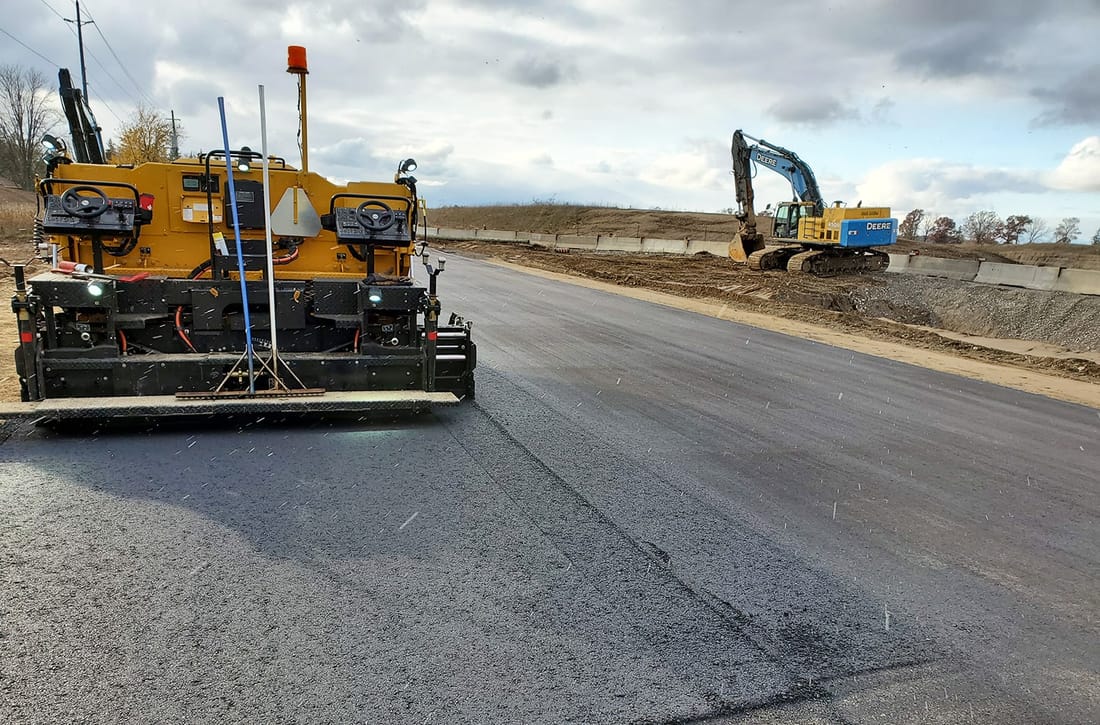
Temperature and timing are critical in Boston’s climate. We schedule hot mix deliveries so that the asphalt arrives at proper laydown temperature even in cooler shoulder seasons. Our paver operators monitor joint locations, head of material, and screed adjustments continuously to maintain consistent thickness and cross-slope. Steel and rubber-tired rollers follow in a planned pattern, starting with breakdown rolling while the mat is still hot, then intermediate and finish rolling to achieve target density and a tight, uniform surface.
We use tack coat between existing surfaces and new asphalt lifts so that they bond as a single pavement structure. Without tack, overlays can slip or delaminate, especially under braking or turning traffic. On municipal work we can supply density and compaction records to confirm that specification requirements have been met.
Drainage, Winter Performance, and Long-Term Durability
Boston’s winters are hard on roads, so good drainage is as important as asphalt thickness. Precision Asphalt Boston designs road paving projects with specific attention to how water will move off and under the pavement throughout the year.
We set precise gutter grades toward catch basins and ensure that utility structures do not create low spots where water can collect and refreeze. On roads that border sidewalks or driveways, we pay close attention to tie-in elevations so snowmelt does not pond at transitions. Where existing drainage infrastructure is limited, we may recommend additional basins, underdrains, or regrading to protect the pavement investment.
Freeze-thaw cycles can amplify any weakness in the pavement system. To resist this, we focus on adequate base thickness, proper compaction of every layer, and high quality aggregates that resist stripping and raveling when exposed to moisture and salt. For roads that see frequent plowing, such as bus routes and emergency access streets, we shape edges and approaches to minimize plow damage and use mixes known to hold up under repeated blade contact.
We also advise municipalities and private road owners on realistic maintenance schedules. Timely crack sealing and seal coats can extend pavement life significantly and delay the need for another major resurfacing. We prefer to plan a maintenance timeline at project closeout so that owners know what to budget and when.
Cost Factors, Phasing, and Traffic Management in Boston
Road paving costs are driven by more than just the price of asphalt per ton. Precision Asphalt Boston breaks down each project by the elements that matter: required pavement thickness, base reconstruction, drainage improvements, utility coordination, traffic control, and working hours.
Inner Boston neighborhoods often require complex traffic management with police details, staged lane closures, and night or off-peak work windows. These items impact both cost and schedule. When we estimate, we do not guess at these numbers. We walk the site, review traffic patterns, and coordinate with the relevant city departments so that our proposal reflects the actual logistics of working on that specific street.
Existing conditions are another major driver. A simple mill and overlay on a structurally sound road is far less expensive than a full-depth rebuild. However, patching over a failing base usually leads to a short-lived fix that costs more in the long run. We provide clear options that show up-front cost, expected service life, and disruption level so you can choose the right approach for your budget and your needs.
Phasing is critical where access must be maintained for residents, businesses, schools, or emergency services. We set up staged construction plans, including temporary surfaces where needed, to keep traffic moving and maintain access to driveways, loading docks, and parking. Our crews are accustomed to working within tight city right-of-ways and coordinating with bus routes, bike lanes, and school traffic patterns.
What to Expect When You Work With Precision Asphalt Boston
From the first site walk to final striping, Precision Asphalt Boston operates with a clear, documented process so municipal clients and private owners know what to expect at each stage.
We start with a detailed consultation that includes a review of any existing plans, a field assessment, and a discussion of traffic and scheduling constraints. We then provide a written proposal that outlines scope, materials, phasing, and any optional upgrades, such as enhanced mixes at intersections or added drainage improvements.
During construction, you can expect clear communication about lane closures, work hours, and milestones. For public streets and municipal roads, we coordinate with city staff on notifications, signage, and inspection schedules. We welcome onsite inspections and can provide compaction data, material tickets, and as-built information as required. Our supervisors are accessible and empowered to make field adjustments when conditions differ from initial assumptions, and we document any changes.
At project closeout, we walk the road with you, confirm that inlets and structures are clear, check joints and transitions, and address any punch list items quickly. We also review a recommended maintenance plan tailored to your specific road type and traffic. Whether you manage a single private road or a network of municipal streets, our goal is straightforward: a road surface that performs as designed and a project experience that is predictable, transparent, and technically sound.